English
Liter Size for Backpacks: How Capacity Is Measured & How Buyers Should Specify It
Created on 03.16
We all want the perfect gear for our next outdoor adventure. Finding the right liter size helps us pack what we need without carrying extra weight. Choosing a pack is easier when we know how brands calculate internal space.
liter size
Most gear makers use the metric system to label their products for consumers. This method looks at total volume rather than just height or width. Our guide to backpack volumes explains these measurements clearly.
Selecting the right capacity ensures we pick a bag that fits our equipment perfectly. We will explore how to compare different models to find your ideal match. Understanding these technical details helps us make informed decisions when shopping for gear.
Key Takeaways
- A single metric unit of volume equals sixty-one cubic inches.
- Capacity measures the internal space, not just the outer dimensions.
- Small daypacks usually hold minimal gear for short trips.
- Most airlines accept carry-on bags up to forty-five linear inches.
- Fit and total volume are separate factors for hikers to consider.
- Visualizing a standard water bottle helps us gauge total space.
What Does Liter Capacity Actually Mean for Backpacks?
Liter capacity in backpacks is more than just a number. It shows how much you can carry. Knowing this helps pick the perfect backpack for your trips.
The metric system is used everywhere to measure backpack volume. It's based on the liter, which is a volume unit.
Understanding Volume Measurement in the Metric System
The metric system makes measuring volume easy. Liter capacity is the volume of the main compartment and extra pockets.
1 liter equals 1,000 cubic centimeters or 1 cubic decimeter. This helps figure out how much stuff a backpack can hold.
Why Manufacturers Use Liters Instead of Cubic Inches
Manufacturers prefer liters over cubic inches because it's a global standard. The metric system is used worldwide, making it easier for everyone to discuss capacity.
Using liters simplifies backpack comparisons. It's a standard unit that requires no conversion.
The Difference Between Liter Capacity and Weight Capacity
It's crucial to understand the distinction between liter capacity and weight capacity. Liter capacity refers to volume, while weight capacity indicates how much weight it can bear.
A backpack with high liter capacity may not be suitable for heavy loads, and vice versa. Understanding this difference aids in selecting the appropriate backpack for your needs.
How Backpack Manufacturers Measure Liter Capacity
Knowing how backpacks are measured is essential for making the right choice. Measuring liter capacity is not straightforward; it depends on numerous factors that influence a backpack's volume.
Industry Standard Testing Methods and Protocols
Backpack makers use various ways to measure liter capacity. They often follow a standard test. This involves filling the backpack with sand or water to find its capacity.
Key testing methods include:
- Water displacement method
- Sand filling method
- Geometric calculation method
Internal Volume vs. Total Packable Volume
It's important to know the difference between internal and total packable volume. Internal volume is the total space inside. Total packable volume is the space left after adding compartments and pockets.
The difference between these two measurements can significantly impact the perceived capacity of a backpack.
How Design and Shape Impact Liter Measurements
The design and shape of a backpack greatly affect its liter measurement. For example, a backpack with complex shapes or many compartments will have a different capacity than a simple pack.
A visually engaging and informative illustration depicting the concept of backpack volume conversion. In the foreground, a high-quality, detailed image of a variety of backpacks with clear volumetric annotations in liters, showcasing different shapes and sizes. The middle layer features a transparent visual guide with measurement scales and diagrams indicating the conversion of backpack size from cubic inches to liters, highlighted in a contrasting color. The background showcases a minimalist outdoor setting, like a hiking trail, with soft natural lighting casting gentle shadows, creating a sense of adventure and exploration. The image should be crisp and well-defined, with an overall atmospherical feel that emphasizes clarity and professionalism, making it perfect for educational purposes.
Why Two Backpacks with the Same Liter Rating May Feel Different
Even if two backpacks have the same liter rating, they can feel different. This is because of design, material, and how things are organized inside. The shape, size, and where compartments are placed all matter.
Feature | Impact on Liter Capacity | User Experience |
Internal Compartments | Reduces total packable volume | Affects organization and accessibility |
External Pockets | Increases total packable volume | Enhances accessibility and convenience |
Compression Straps | Can compress or expand capacity | Improves fit and stability |
Breaking Down Backpack Sizes: What Each Liter Range Offers
The liter capacity of a backpack is more than just a number. It shows how much gear you can carry. Knowing the different liter ranges is key to picking the right backpack.
Backpacks vary in size, each for different activities and times. Let's look at the typical liter ranges and their uses.
Compact Daypacks: 10-20 Liters for Essentials Only
Compact daypacks are great for short trips or daily commutes. They hold 10 to 20 liters. Perfect for a laptop, water bottle, and snacks.
Standard Daypacks: 20-35 Liters for Work and Short Hikes
Standard daypacks have more space, from 20 to 35 liters. They're good for work, school, or short hikes. They fit extra layers, lunch, and daily needs.
Weekend Packs: 35-50 Liters for Overnight Adventures
For weekend trips or overnight adventures, choose packs of 35 to 50 liters. They hold enough for a couple of days, like clothes, toiletries, and camping gear.
Expedition Backpacks: 50-80+ Liters for Extended Trips
Expedition backpacks are for longer trips, with 50 liters or more. They carry lots of gear, like sleeping bags and tents. Ideal for long hikes or backpacking trips.
Choosing a backpack involves more than just liter size. Comfort, durability, and features matter too. But knowing the liter size helps narrow down your choices. It ensures you find a pack that fits your needs.
How to Choose the Right Liter Size for Your Activities
Packing the right gear starts with picking the right backpack size. It's important to match the backpack's liter capacity to your needs.
Matching Capacity to Trip Duration and Season
The length of your trip and the season matter a lot. For short trips, a smaller backpack works well. But for longer trips, you'll need more space.
- For day trips, 20-35 liters is often sufficient.
- Weekend getaways typically require 35-50 liters.
- Extended trips may need 50-80 liters or more.
Seasons also affect how much you need to carry. In colder seasons, you'll need more room for warm clothes.
Considering Your Packing Style and Gear Volume
Your packing style affects the size you need. Light packers might choose smaller backpacks. But if you carry a lot, you'll need more space.
Key considerations include:
- The type and size of your gear.
- How you pack your clothes (e.g., rolling vs. folding).
- Any special equipment for activities.
Accounting for Body Size and Torso Length
Your body size and torso length are important. Larger people or those with longer torsos might need bigger backpacks for comfort.
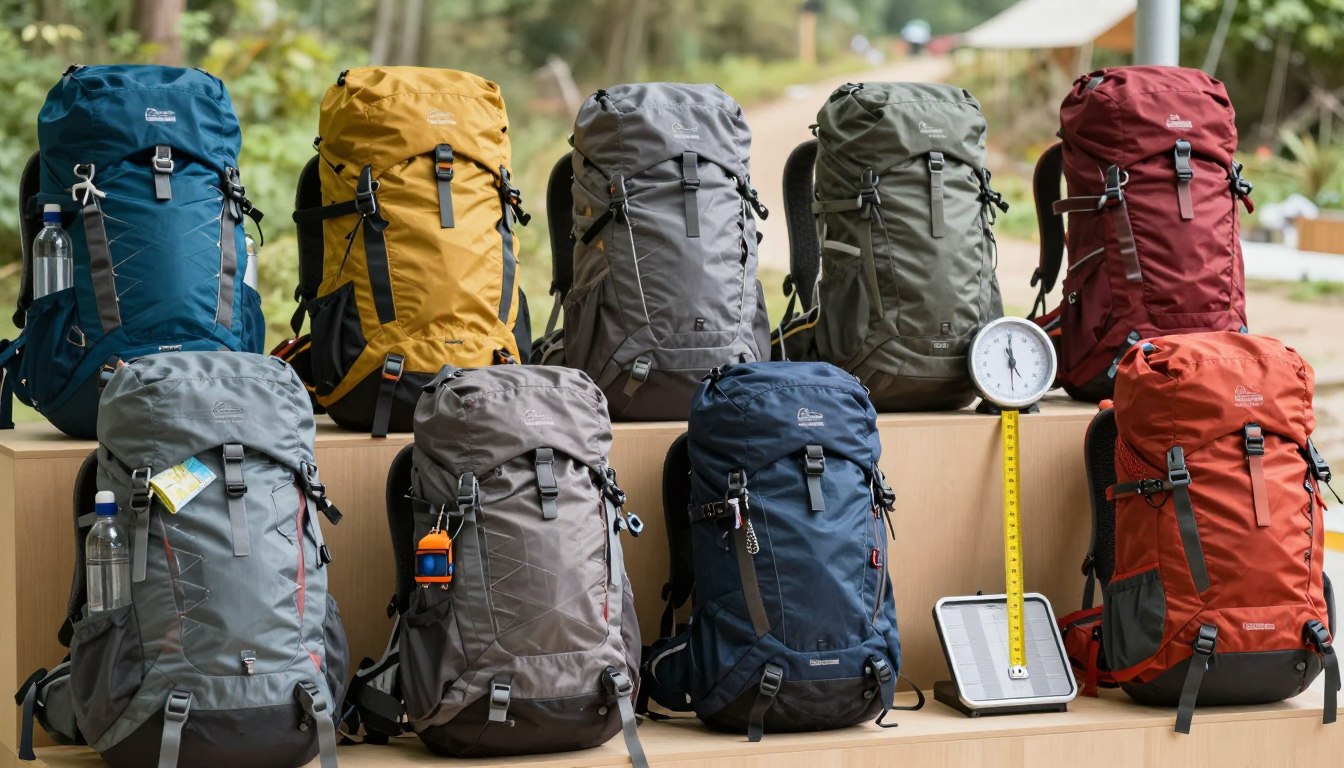
A detailed arrangement of various types of backpacks on display, showcasing their liter capacities. In the foreground, a variety of backpacks of different sizes and shapes, some filled with gear like water bottles, maps, and climbing equipment, emphasizing their functionality. In the middle ground, a measuring tape and a scale, symbolizing capacity measurement, are placed next to a backpack for context. The background features a serene outdoor setting, perhaps a hiking trail or a campsite, bathed in soft, natural light, enhancing a sense of adventure. The shot is taken from a slightly elevated angle to capture the composition. The atmosphere should be inspiring and informative, inviting viewers to consider their own backpacking needs while reflecting the variety of options available.
When to Size Up or Down from Standard Recommendations
Standard sizes are helpful, but sometimes you need to adjust. If you're tall or have a larger build, you might need a bigger backpack, even for short trips.
"The best backpack is one that fits you perfectly and meets your specific needs. Don't be afraid to size up or down based on your unique requirements."
Think about these factors to pick the perfect backpack size. This way, you'll be ready for your adventures without feeling weighed down.
Converting Liters to Gallons, Quarts, and Other US Measurements
Backpack capacity is often in liters, but US units can be confusing. Knowing how to change liters to gallons, quarts, and fluid ounces helps a lot. This is useful when picking a backpack.
Quick Liter to Gallon Conversion for Backpack Shoppers
To change liters to gallons, remember 1 gallon is about 3.785 liters. So, divide liters by 3.785 to get gallons. For example, a 30-liter backpack is about 7.92 gallons (30 liters / 3.785 liters per gallon).
Use online tools like https://www.unitconverters.net/volume/liters-to-gallons.htm for fast conversions.
Here's a simple table to show liters to gallons:
Liters | Gallons |
10 | 2.64 |
20 | 5.28 |
30 | 7.92 |
40 | 10.57 |
50 | 13.21 |
Understanding Liter to Quart and Fluid Ounces Conversions
Knowing how to convert to quarts and fluid ounces is also useful. 1 quart is about 0.946 liters. Divide liters by 0.946 to get quarts. For fluid ounces, 1 liter is about 33.81 fluid ounces. Multiply liters by 33.81 to convert.
A 20-liter backpack is about 676.2 fluid ounces (20 liters * 33.81 fluid ounces/liter).
Visualizing Backpack Capacity Using Everyday Objects
Relating backpack capacity to everyday items helps. A standard water bottle is about 0.5 liters or 16.9 fluid ounces. So, a 30-liter backpack can hold about 60 water bottles.
If you know the volume of your laptop, clothes, or other gear, you can guess if a backpack is big enough.
By understanding these conversions and relating them to familiar objects, you can make better choices when picking a backpack.
What Affects the Usable Space in Your Backpack
Knowing what affects a backpack's space is key to a good buy. It ensures your stuff fits well and is easy to get to.
The space in a backpack isn't just about its size. Design features play a big role in how much you can pack and reach your gear.
How Internal Compartments Reduce Overall Capacity
Internal compartments help organize your stuff but cut down on space. They make your gear easy to find but use up room for packing.
For instance, a laptop sleeve or pocket for small things is handy. Yet, they take up space for other items. Think if the extra features are worth less room for packing.
The Impact of Frame Design and Suspension Systems
The frame and suspension system are key for comfort and spreading out the weight. But, they also eat into the space inside. A sturdy frame and system might mean less room for your stuff.
Frame Design Comparison
Frame Type | Impact on Usable Space | Comfort Level |
Internal Frame | Moderate Reduction | High |
External Frame | Significant Reduction | Medium |
Frameless | Minimal Reduction | Low |
External Pockets, Straps, and Expandable Features
External pockets and straps add convenience but might cut down on space. They give more storage but can make the backpack bigger and less sleek.
Expandable features, like zip-out parts or bigger pockets, boost capacity when needed. Yet, they add bulk or weight when not used.
When picking a backpack, weigh the importance of organization, comfort, and space. Knowing how design elements affect space helps you choose wisely for your needs.
What Specifications to Request When Shopping for a Backpack
Choosing the right backpack is more than just looking at the liter capacity. It's about understanding the details that really matter. Knowing what to ask manufacturers can help you make a smart choice.
Essential Liter Capacity Details to Ask Manufacturers
First, ask about the backpack's liter capacity. But don't just focus on the total volume. Find out about the main compartment volume and the total volume, including any external pockets. This helps you organize your gear better.
How to Verify Advertised Volume Claims
Manufacturers don't always measure volume the same way. This can cause differences in what's advertised versus what's real. Look for manufacturers that provide detailed measurement methods or third-party certifications. Also, check reviews to see if the backpack's actual capacity matches what's advertised.
Questions About Compression and Expansion Capabilities
The backpack's ability to compress or expand is important. Ask about the compression straps and how they affect the volume. Also, find out if there are expandable compartments or pockets that can increase the capacity when needed.
Getting Accurate Measurements for Main Compartment vs. Total Volume
It's key to know the difference between the main compartment volume and the total volume. The main compartment is for bulkier items, while external pockets are for smaller items. Request detailed measurements for both to ensure the backpack fits your needs.
By asking the right questions and understanding the specifications, you can find a backpack that perfectly suits your needs. Whether you're hiking, traveling, or commuting, the right backpack is crucial. It's not just about capacity, but how you use that capacity.
Conclusion
Knowing about liter size is key when picking the right backpack. We've looked at how to measure liter capacity, the differences in sizes, and how to choose the best one for you. This is based on your activities and how you pack.
When looking for a backpack, think about how long you'll be traveling, how much gear you need, and your body size. This helps find a backpack that fits your stuff and meets your adventure needs.
With this knowledge, you're ready to pick the right backpack for your next adventure. Whether you're commuting daily or hiking often, the right size will make your backpack better.
FAQ
Why do backpack manufacturers use the metric system for liter measurements?
The metric system makes it easier to measure liters because 1 liter is exactly 1,000 milliliters. Brands like Osprey and Patagonia can share the total liter capacity with everyone. This way, we can easily compare different backpacks from different brands.
How can I perform a quick volume conversion from liters to US measurements?
To convert liters to quarts, remember that one liter is about 1.06 quarts. This makes it easy to do quick math. For gallons, a 40-liter backpack is about 10.5 gallons. For smaller items, 33.8 ounces is roughly one liter, the size of a large Nalgene water bottle.
What is the difference between total volume and usable space in a backpack?
The total volume is what the pack can hold, but the usable space is what you can actually use. For example, a Mystery Ranch pack might have the same volume as a Hyperlite Mountain Gear bag. But the Hyperlite might feel roomier because it doesn't have rigid parts inside.
Which liter size is most appropriate for a standard weekend hiking trip?
For a weekend trip, look for a pack with 35 to 50 liters. The REI Co-op Flash 55 is a good example. It has enough space for a tent, sleeping bag, and food without being too big.
How do I know if the liter measurements include the external pockets?
It depends on the brand. Look for the ASTM F2153 testing standard. Some brands, like Gregory Mountain Products, only list the main compartments. Others include the side mesh pockets. Always ask the manufacturer about the external storage.
Can I use fluid ounces to liters to figure out my hydration needs?
Yes! Use fluid ounces to liters to plan your hydration. Most hydration bladders are 2 or 3 liters. Knowing this helps you plan your space for clothes and tools.
Why would two backpacks with the same 30-liter rating fit differently?
The liter size only shows volume, not how the pack fits. A tall, thin 30-liter pack will feel different than a wide, squat one. The fit and how the pack distributes weight are key, not just the volume.
Contact
Leave your information and we will contact you.


