English
Backpack Capacity Guide: Litres vs Dimensions, Use Cases & OEM Spec Checklist
Created on 03.16
Finding the right gear for your daily commute or a mountain trek can be puzzling. It's confusing to deal with different measurements and specs. We aim to simplify your choice and reduce stress.
backpack capacity
Many find it hard to balance volume with physical dimensions. We think knowing the difference between liters and inches is key for maximum comfort on your travels. Whether you're a casual hiker or a city worker, the right fit makes all the difference.
Our guide helps you understand OEM details and match them to your lifestyle. We'll explore internal capacity and storage metrics to ensure your next purchase is a success. We want you to find the perfect gear without any confusion.
Key Takeaways
- Compare internal volume against physical gear dimensions.
- Identify the best storage options for specific activities.
- Interpret technical specs for better long-term durability.
- Enhance carrying comfort with correct volume selection.
- Recognize how shape impacts your storage efficiency.
- Select the right gear to meet travel regulations.
Understanding Backpack Capacity: What the Numbers Really Mean
When we talk about backpack capacity, it's not just about the numbers. It's about what those numbers really mean for how much you can carry. Backpacks are measured in litres or by their dimensions. But what do these numbers actually tell us?
Volume Measurement in Litres Explained
Backpacks are often measured in litres to show how much they can hold. But, how they measure litres can differ. Some use "packing blocks" to fill the backpack and measure it. Others use computer-aided design (CAD) to figure out the volume.
Key factors affecting litre measurement include:
- The shape and design of the backpack
- The presence of compartments and pockets
- How the manufacturer's measurement technique compares to others in the industry
Linear Dimensions vs Actual Storage Space
Linear dimensions give us a basic idea of a backpack's size. But, they don't always show how much you can actually store. The backpack's shape, padding, and pocket design all play a part in its storage capacity.
For instance, a tall, narrow backpack might have the same volume as a shorter, wider one. But, the usable space can be very different because of the design.
Why Manufacturers Use Different Measurement Standards
Backpack makers use different ways to measure capacity, making it hard to compare them. Some measure the outside dimensions, while others look at the inside volume. Knowing these differences helps us make better choices when picking a backpack.
Measurement Standard | Description | Impact on Capacity Measurement |
External Dimensions | Measuring the backpack's external length, width, and height. | May overestimate capacity due to external padding or irregular shapes. |
Internal Volume | Calculating the volume of the main compartment and other pockets. | Provides a more accurate representation of usable space. |
Packing Blocks Method | Filling the backpack with standard blocks to measure volume. | Can give a realistic measure of packing capacity but may vary with block size. |
Understanding these points helps us choose the right backpack for our needs.
Litres vs Dimensions: How to Compare Backpack Sizes Accurately
Choosing the right backpack means knowing the difference between litres and dimensions. It's not just about numbers. There's more to it.
"The design and construction of a backpack greatly affect its storage capacity," says an outdoor gear expert. This shows why we should look beyond just volume or size when comparing backpacks.
The Litre System: Industry Standard for Backpack Volume
The litre system is the standard for measuring backpack volume. It makes it easy to compare different models. Most manufacturers use litres to show a backpack's capacity.
But, the litre capacity can vary. Manufacturers often use packing cubes or materials to measure accurately. This simulates real-world use.
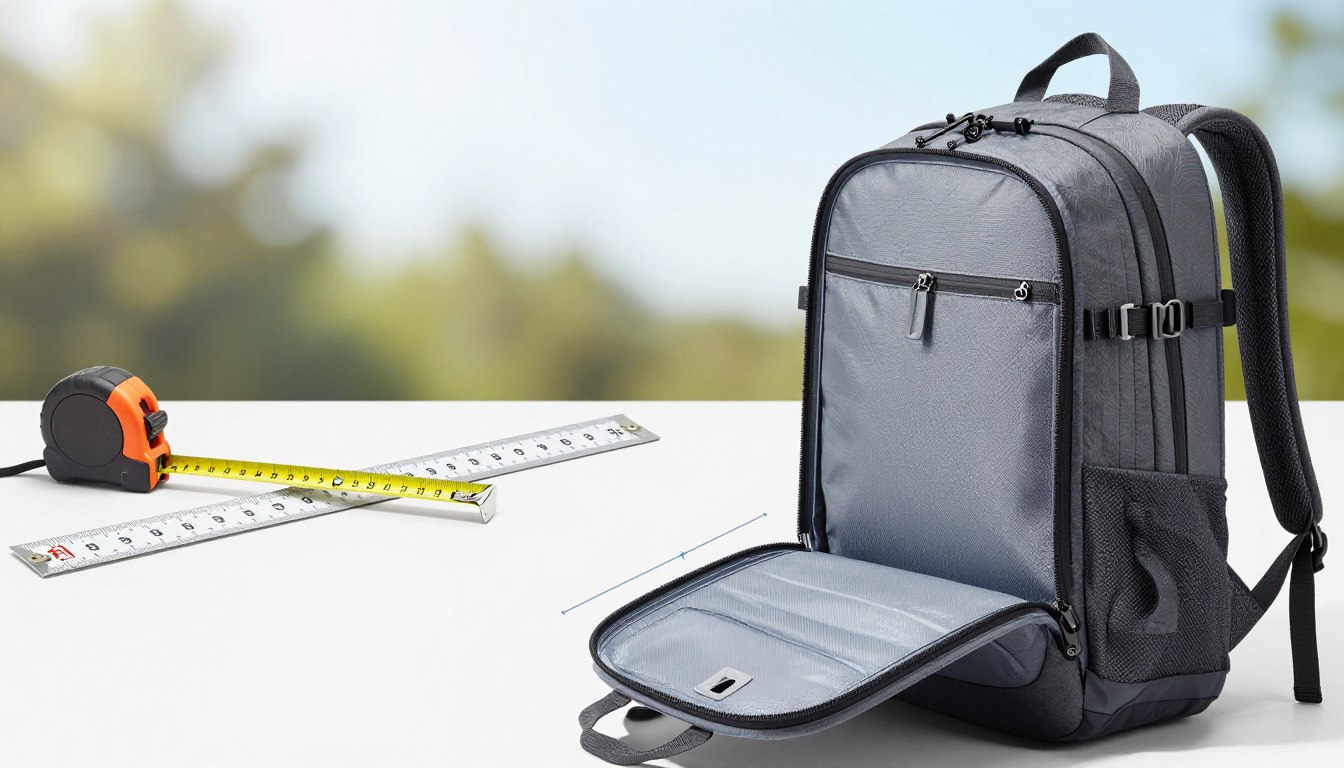
A well-organized visual representation of backpack capacity, focused on the comparison between liters and dimensions. In the foreground, a sleek, modern backpack is displayed, partially open to reveal its interior, showcasing its size. The middle ground features a measuring tape and a ruler laid across a flat surface, emphasizing precise measurements. In the background, a blurred outdoor setting evokes adventure, subtly hinting at various use cases for the backpack, like hiking or travel. The lighting is bright and natural, creating a sense of clarity and focus, with soft shadows to add depth. The angle is slightly elevated, providing a comprehensive view of the backpack while maintaining a professional and informative atmosphere.
Converting Dimensions to Actual Capacity
Litres show a backpack's volume clearly. Dimensions also help understand its size and shape. To convert dimensions to capacity, manufacturers use complex algorithms.
But, this method isn't always right. It doesn't consider padding, pockets, and design elements. So, relying only on dimensions can be misleading.
Internal vs External Measurements: What Matters Most
Internal and external dimensions are both important when measuring backpack capacity. External measurements show the backpack's size. Internal measurements show the actual space for your gear.
Internal measurements are key when comparing sizes. They directly affect how much gear you can carry. A larger external size doesn't always mean more storage.
Shape and Design Impact on Usable Space
The shape and design of a backpack greatly affect its space. A well-designed backpack with compartments offers organized storage. A simple design may offer more flexibility.
The backpack's shape also affects comfort and weight distribution. A curved shape may be more comfortable but could reduce storage capacity.
Understanding these factors helps you choose the right backpack for your needs.
Backpack Capacity by Use Case: Finding Your Perfect Size
The right backpack size changes based on how you use it. Whether it's for daily trips or long hikes, the size matters. We'll look at the best sizes for different activities to help you pick the perfect one.
Daypacks and Urban Commuting (10-25 Litres)
For city commutes or short outings, a 10-25 litre daypack works well. These packs hold your laptop, water, and clothes. Look for comfort, pockets, and durability.
- Comfortable padding and adjustable straps
- Multiple compartments for organization
- Durable materials and weather resistance
Day Hiking and School Backpacks (25-35 Litres)
For day hikes or school, a 25-35 litre backpack is best. It fits extra clothes, snacks, and more without being too heavy. Choose packs with hydration sleeves and strong materials.
Overnight and Weekend Trips (35-50 Litres)
For short trips, a 35-50 litre backpack is perfect. It holds clothes, toiletries, and more for a weekend away. Packs with lots of pockets help keep things organized.
- Multiple compartments for organization
- Weather-resistant materials
- Comfortable hip belt and backpanel
Multi-Day Backpacking (50-70 Litres)
For longer hikes, a 50-70 litre backpack is needed. It can carry more items for extended trips. Look for packs that are weatherproof and have a comfy hip belt.
Extended Expeditions and Travel (70+ Litres)
For long trips or travel, choose a backpack over 70 litres. These big packs hold lots of gear for extended journeys. Find ones with extra space and strong build.
Factors That Affect Maximum Backpack Capacity
The capacity of a backpack depends on several important factors. These factors affect how useful and long-lasting a backpack is. Knowing these elements helps you pick a backpack that fits your needs and lasts long.
Material Durability and Weight Capacity Limits
The material of a backpack greatly influences its capacity. Strong materials can carry more weight. But, there's a limit to how much any material can handle. Manufacturers set a weight capacity for their backpacks, showing the maximum safe load.
For example, a backpack for heavy use might have strong nylon fabric. This fabric can handle a lot of weight without breaking down.
To learn more about how backpack weight capacity is determined, you can visit this forum discussion on the topic.
Frame Design and Load Distribution
The backpack's frame design is key to its capacity. A good frame spreads the weight evenly, allowing for more weight. Frames can be inside or outside, with inside frames offering better load distribution.
The frame's shape and strength are crucial. They decide how much gear a backpack can carry comfortably.
Compartmentalization vs Open Storage
Compartmentalization affects a backpack's capacity. Many compartments help organize gear, making it easy to find what you need. But, too many can cut down on space.
Open storage designs offer flexibility but can lead to mess. The choice between compartments and open storage depends on your needs and activities.
Expandable Features and Compression Systems
Some backpacks have features like expandable parts or compression systems. These allow you to adjust the capacity as needed. Expandable packs add space when you need it, while compression systems keep gear in place.
These features make a backpack versatile for different situations.
To show how these factors impact capacity, let's compare:
Feature | Impact on Capacity | Benefit |
Material Durability | Increases weight capacity | Enhances longevity and safety |
Frame Design | Affects load distribution | Improves comfort and stability |
Compartmentalization | Organizes gear, may reduce overall capacity | Enhances accessibility and organization |
Expandable Features | Increases flexibility in storage | Adapts to varying needs |
A detailed illustration showcasing several backpacks of varying sizes and shapes, displayed prominently in the foreground. Each backpack is open, revealing different packing scenarios, including camping gear, laptops, and textbooks, highlighting the factors that influence their maximum capacity. In the middle ground, a chart with graphical representations of volume in liters versus dimensions, accompanied by thought bubbles illustrating weight distribution and material types. The background features a serene park setting with soft natural lighting, captured with a wide-angle lens to emphasize depth. The mood is informative yet inviting, encouraging readers to understand how various elements affect backpack capacity. No text, logos, or watermarks present.
By considering these factors, you can find a backpack that meets your needs. It should be comfortable and durable. Whether for a day hike or a long trip, knowing what affects a backpack's capacity is key.
OEM Spec Checklist: Essential Specifications for Backpack Sourcing
A detailed OEM spec checklist is key for making sure backpacks are top-notch. When looking for backpacks, it's important to check several key specs. This ensures the final product is of high quality, performs well, and is functional.
Core Volume and Dimension Specifications
Knowing the core volume and dimensions is crucial. It helps figure out the backpack's storage space and size. You need to measure its length, width, height, and internal volume in liters. Accurate measurements are key to match the backpack with its intended use, like daily use, hiking, or travel.
- Measure length, width, and height
- Determine internal volume in liters
- Consider the intended use case
Weight Capacity and Load-Bearing Requirements
The weight capacity and load-bearing needs of a backpack are very important. They affect its durability and comfort. Manufacturers should state the max weight it can carry, based on material strength and frame design. Proper load distribution is also crucial to avoid back and shoulder strain.
- Specify maximum weight capacity
- Consider material strength and frame design
- Ensure proper load distribution
Material Specifications and Durability Standards
The material used greatly impacts the backpack's durability, water resistance, and weight. Materials like nylon, polyester, and canvas have different benefits. It's important to choose materials that meet durability standards for various conditions and uses.
Compartment Layout and Accessibility Features
A good compartment layout makes the backpack more functional and user-friendly. It's about the number and size of compartments, pocket placement, and features like zippers and buckles. Efficient organization and easy access to items are key.
Strap Systems and Adjustment Mechanisms
The strap system and adjustment mechanisms are vital for comfort and fit. Adjustable straps, belts, and sternum straps help spread the load evenly and secure the fit. Ergonomic design ensures comfort during long wear.
Quality Control and Testing Parameters
Manufacturers must test backpacks rigorously to ensure quality. Tests cover material durability, seam strength, and construction quality.Stock OEM backpack production should follow these tests to ensure quality.
By using this detailed checklist, manufacturers and buyers can make sure their backpacks meet the highest standards. This ensures quality, performance, and functionality.
Conclusion
Knowing how much a backpack can hold is key to picking the right one. We've looked at how litres and size affect storage. We've also seen how different backpacks work for daily trips or long journeys.
When choosing a backpack, think about its durability, frame, and how it's organized. Our checklist helps you pick a backpack that fits your needs.
Remember, litres and size are just the beginning. The best backpack is one that's comfortable and meets your needs. By focusing on what you need, you'll find the perfect backpack for you.
FAQ
How can we distinguish between backpack liter capacity and backpack dimensions when shopping?
Backpack dimensions show the bag's size, but liter capacity shows how much it can hold. A big bag might have lots of padding, making it less useful. Always check the inside space to make sure it fits what you need.
What is the recommended backpack size for daily commuting and urban use?
For daily use, a 10 to 25 liter backpack is best. Brands like Aer and Peak Design offer great options. They fit laptops, chargers, and jackets without being too big.
Why do different manufacturers like Osprey and Deuter use different standards to calculate backpack volume?
Brands have different ways of measuring because of how they include pockets and shrouds. Always look at the spec sheet to know what's included. This helps avoid surprises.
How does the internal frame design affect the maximum backpack capacity?
Internal frames help spread weight but might reduce the main space. This trade-off lets us carry more with better support. It's a key benefit.
Can the shape of a bag influence the efficiency of the backpack volume?
Yes! A square bag is better than a teardrop for packing. Brands like Patagonia make travel packs that are great for packing cubes. This maximizes space.
What should we look for regarding backpack weight capacity in heavy-duty gear?
Look at the fabric's denier and the load-lifter's strength. Brands like Mystery Ranch focus on these to ensure the pack can handle heavy loads.
Is there a major difference between internal and external backpack dimensions?
Yes, it matters a lot for travelers. External size is for carry-on rules, while internal size is for what fits inside. Make sure your items fit within the pack's walls.
What are the essential items to include on an OEM spec checklist for backpack sourcing?
Include liter capacity, weight capacity, and material quality. Also, check the compartment layout and adjustment quality. This ensures the backpack meets your needs.
Contact
Leave your information and we will contact you.


